
Carbon Management Plan 2025
Download HERE
1. Carbon Management Policy
At IML, we manage and reduce our greenhouse gas emissions so we can be a net zero business. We make this
happen by:
- Measuring our emissions: What you measure, you can manage. We assess and report our carbon footprint on an annual basis.
- Managing our emissions: We have a carbon management plan (this document) to make sure we activelyplan to reduce our emissions..
- Setting meaningful targets: By setting targets to reduce emissions year on year we can be clear on whatwe can review where we are, and what we are aiming for. We can also look honestly at what we have achieved to understand whether we have done enough to achieve our goals.
- Offsetting our remaining emissions: Where we can’t eliminate emissions, we offset them. The scope will include Scope 1, 2 and 3 emissions.
2. Carbon Management Plan
2.1 Scope
There are 3 categories of emissions as follows:
- Scope 1 emissions— the Green House Gas (GHG) emissions that a company makes directly.
- Scope 2 emissions — these are the emissions it makes indirectly – such as when the electricity or energy it buys for heating and cooling buildings, is being produced on its behalf.
- Scope 3 emissions — this includes all the emissions associated, not with the company itself, but that the organisation is indirectly responsible for, up and down its value chain. At IML our carbon footprint includes the following categories under each scope:

2.2 IML’s Carbon Management Process

2.3 Carbon Reduction Target
We aim to reduce our annual carbon footprint by at least 5% per year on an ongoing basis. This target will be
reviewed annually in line with baseline carbon footprint measurements and feasibility of further reduction.
3. Carbon Footprint Tracking
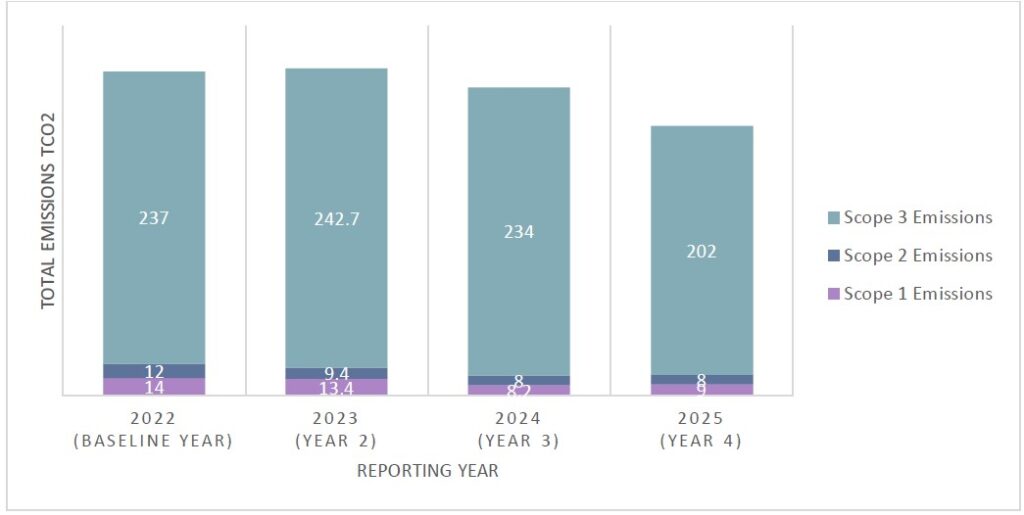
3.1 Baseline Carbon Footprint (2022)
Baseline emissions are a record of the greenhouse gases that have been produced in the past and were produced
prior to the introduction of any strategies to reduce emissions. Baseline emissions are the reference point against
which emissions reduction can’t be measured.
The baseline year for comparing future carbon footprint reductions is 01/01/2022 to 31/12/2022.
| Emission Source | tCO₂e |
|---|---|
| Scope 1 | 14 |
| Scope 2 | 12 |
| Scope 3 | 237 |
| Total | 263 |
Baseline emissions were independently verified by MacArthur Green Consultancy.
3.2 Current Carbon Footprint (Year 4 2025)
| Emission Source | tCO₂e |
|---|---|
| Scope 1 | 9 |
| Scope 2 | 8 |
| Scope 3 | 202 |
| Total | 219 tC02e |
3.3 Emissions Reduction (2022–2024)
3.4 What we did during Year 4
This year we have reduced our overall carbon footprint by 13%. Here are some of the measures we took during
2025 to reduce our overall carbon footprint.
- Maintained our ISO14001 certification – this helps us monitor and control our processes relating to the environment.
- Worked with our building management to ensure all our general waste is no longer going to landfill and is instead incinerated to generate energy. This has made the biggest contribution to our reduction figures.
- Continued to promote mindful travel practices including the use of video conferencing where possible.
4. Carbon Reduction Plan
4.1 Acknowledgments of Company’s Restrictions
We moved into new office premises in January 2024 and energy efficiency was a key factor in the selection of our
new premises. The new office building has an EPC rating of A with a target of achieving net zero for the entire
building by 2030.
As the operational environment becomes more challenging and projects require face to face interaction this has
meant an increase in our business travel. Whilst we cannot reduce the amount of business travel required, we can
promote mindfulness when travelling, better planning of in person meetings and the use of more eco-friendly
travel options where possible.
4.2 Emission Reduction Projects
To ensure we maintain our net zero carbon emission stats, we aim to reduce our carbon footprint by 5% per year per capita year on year.
4.3 Carbon Reduction Projects
The following environmental management measures and projects are in the process of being implemented following the verification of our 2022 baseline.
TR01 – Maintain ISO14001 Certification
- Owner: IML Compliance
- Measurement: Annual external audits.
TR02 – ESG Training Plan
- Owner: IML Compliance
- Objective: Develop and ESG training plan to increase employee awareness.
- Measurement: Astute Training Reports
TR03 – Public Transport / Travel
- Owner: IML Compliance
- Objective: Encourage greater usage of public transport in particular trains rather than flights. This will be achieved through our travel season ticket payment plan, our EV scheme and ride to work scheme.
- Measurement: IML Expenses & Travel Reports
5. Carbon Offsetting Plan
In order to achieve net zero status, we have committed to offsetting any remaining carbon footprint.
Our offset projects and methodology for offsetting will meet the following principles:
- The offsets we purchase or the allowance credits we surrender represent genuine, additional GHG emission reductions elsewhere.
- The projects involved in delivering our offsets meet the criteria of additionality, permanence, leakage, and double counting.
- Our carbon offsets are verified by an independent third-party verifier.
- Our credits from carbon offset projects are only issued after the emission reduction associated to the offset project has taken place.
- Our credits from carbon offset projects are retired within 12 months from the data of the declaration of achievement of carbon neutral status.
- Our credits from carbon offset projects are supported by publicly available project documentation on a registry which provides information about the offset project, quantification methodology and validation and verification procedures.
- Our credits from carbon offset projects are stored and retired in an independent and credible registry.
5.1 IML’s Approach to Offsetting
IML will offset our residual emissions by purchasing carbon credits through verified projects.
Exactly what carbon credit projects IML uses will be decided by IML by Q3 2026. For us that means projects
verified against:
- Gold Standard; or
- Certified Emission Reductions (CERs).
6. Declaration
Emissions have been reported and recorded in accordance with the published reporting standard for Carbon
Reduction Plans and using the appropriate Government emission conversion factors for greenhouse gas company
reporting.
This Carbon Management Plan has been reviewed and signed off by the Executive Committee.
Signed on behalf of Infrastructure Managers Limited

Steve Cooper – Chief Executive Officer
Date: May 28, 2026
Note: 1 Government conversion factors for company reporting of greenhouse gas emissions – GOV.UK (www.gov.uk)